
The Project Manager’s Guide to Risk: Spotting Problems Before They Happen
Most project risks don’t announce themselves, they surface quietly in missed signals, untested assumptions, and familiar patterns. This article explores how experienced project managers identify risk early, using practical methods and disciplined attention to preserve choice before problems escalate.
RISK MANAGEMENT
Iyanna Trimmingham
1/17/20264 min read

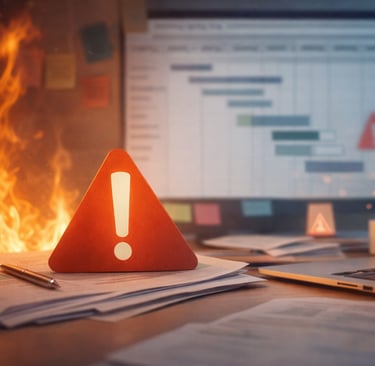
You’re three weeks into a product launch when engineering mentions, almost casually, that the API integration everyone assumed was straightforward actually requires security approvals that take six weeks. Or you’re reviewing the budget and realize no one accounted for user testing. Or a key stakeholder who’s been quiet suddenly surfaces with concerns that could derail the entire approach.
These moments don’t feel like risks materializing. They feel like ambushes.
But here’s what experienced project managers know: most project problems announce themselves long before they explode. The issue isn’t that risks are invisible. It’s that we’re often too busy executing to notice them forming.
Risk management, in real project work, isn’t about prediction. It’s about attention.
What Risk Identification Means in Practice
Risk identification isn’t about maintaining an exhaustive register of everything that could theoretically go wrong. In real projects, it’s about developing awareness, knowing where your plan is most exposed, and creating space to look at those areas honestly before they force your hand.
Practically speaking, it means asking questions like:
What assumptions are we making that we haven't validated?
What dependencies exist that we haven't confirmed?
Where are we operating with incomplete information?
This isn’t catastrophic thinking. It’s disciplined curiosity. The difference between projects that recover smoothly and those that lurch from crisis to crisis often comes down to whether someone deliberately looked for problems while there was still time to respond thoughtfully.
From Theory to Action: Three Practical Methods
While intuition develops with experience, it’s built on repeatable practices. Here are three methods anyone can use to start paying better attention.
The "What's Different?" Conversation (Brainstorming)
Instead of a generic "what could go wrong?" brainstorm, frame the conversation with specific prompts. Get the core team in a room and ask targeted questions:“What’s different about this project compared to the last one?” (This surfaces unique technical, stakeholder, or environmental risks.)
“What part of this plan feels like magic?” (This reveals gaps in logic or unvalidated assumptions.)
“If this project were to fail, what would be the most likely cause?” (This gives people permission to voice their biggest fears.)
The Assumption Test
Every project plan is built on a stack of assumptions. The goal is to make them visible and test them.List them out: What are we assuming about vendor timelines, team availability, stakeholder approvals, or technical stability? Write them down.
Ask "what if?": For your top 3-5 assumptions, ask, "What is the impact if this assumption is wrong?"
Validate: The act of asking the question often points to the action. An assumption about legal approval becomes a simple email to confirm it. Confidence feels good; validation protects outcomes.
The Checklist as a Prompt, Not a Rulebook
Checklists get a bad rap, but they aren't meant to replace thinking, they're meant to trigger thinking. Use past projects or a simple category list (e.g., Budget, Scope, Resources, Technology) to prompt your analysis. It prevents you from forgetting entire categories of risk. Did the last project get stalled by procurement? Your checklist should remind you to scrutinize vendor contracts this time.
What This Looks Like in a Real Project
Imagine a mid-sized software implementation. The timeline is aggressive, the team is capable, and the scope is clear. On paper, it looks solid. But during a deliberate risk conversation, a more nuanced picture emerges. The vendor’s integration usually takes two weeks, but this client uses a custom authentication system. The IT security team hasn’t been formally engaged yet. And the client’s main point of contact is about to go on parental leave.
None of these issues were in the original plan. They surfaced because someone slowed down to ask better questions. That conversation led to three early adjustments: engaging IT security immediately, identifying a backup contact, and adding buffer to the integration milestone. The risk didn’t disappear; it just didn’t surprise anyone when it showed up.
The Expert's Mindset: Moving Beyond the Methods
Seasoned project managers eventually internalize these practices. Risk identification becomes less of an event and more of a continuous state of awareness. It shows up in how they listen, how they structure conversations, and how they interpret what’s happening beneath the surface.
Pattern recognition matters more than checklists. Checklists can be useful early on, especially when experience is still forming. Over time, however, seasoned project managers rely less on lists and more on recognizing familiar patterns as they emerge. A vendor who suddenly takes longer to respond. A technical lead who shifts from “no problem” to “should be fine.” A stakeholder who repeatedly postpones reviews. None of these are issues on their own, but they’re signals worth noticing.
Conversations reveal more than documentation. Risk often appears first in side comments and one-on-ones. When someone says they’re “a little concerned,” that’s data. When a stakeholder says they “think” legal will be fine, that’s a cue to confirm. People usually signal uncertainty before they’re ready to escalate it formally.
Reflection: Where Are You Operating on Assumptions?
Think about your current project, not the risks you’ve documented, but the areas where you’re just assuming things will work out.
Where are you relying on availability you haven’t confirmed?
What technical approach feels “low risk” simply because it worked before, even though the context is different?
Which part of your plan would feel uncomfortable to defend if asked how confident you really are?
Those moments of discomfort often point directly to your most meaningful risks.
The Takeaway
Risk identification isn’t about perfect foresight. It’s about creating deliberate space to ask honest questions while you still have options. The strongest project managers aren’t the ones who avoid risk altogether. They’re the ones who notice it early enough to adjust, quietly, deliberately, and without urgency, before momentum hardens into obligation.
Surprises don’t disappear. But when you’ve paid attention early, they become choices.
And that’s where experienced project leadership really shows up.
Subscribe to PMProSkillz!

Delivery failure is rarely about effort. It is about architecture.