
When Urgency Becomes the Only Priority System
Most teams don’t choose urgency as their priority system, they drift into it, one reasonable decision at a time. This piece examines how that drift happens, what erodes quietly along the way, and the subtle shifts that help teams regain control without adding friction.
Iyanna Trimmingham
1/10/20263 min read
Most teams don’t decide to run on urgency.
I’ve watched capable, thoughtful teams slowly train themselves to respond only to it. It doesn’t happen in a dramatic moment. It happens in ordinary meetings, under reasonable pressure, with people trying to be helpful. Over time, urgency stops being a warning and becomes the system. The shift is quiet enough that most teams don’t notice until something starts to feel off.
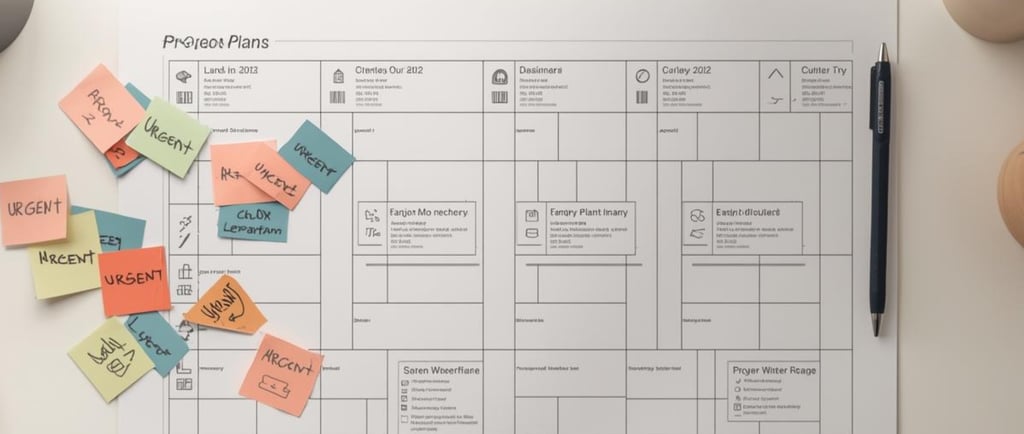
The morning standup runs long because three people need something “today.” By lunch, two more requests arrive marked urgent. Someone asks which fire to fight first, and the answer is always the same: whichever one is burning loudest.
Eventually, urgency stops being a signal and becomes the baseline. When everything is urgent, teams stop asking what should be prioritized and start responding to volume instead of intent. The distinction matters, but it disappears quietly.
Why It Persists
Urgency feels like momentum. It creates visible activity, fast responses, quick pivots, all-hands efforts to close a gap. In the moment, it looks like execution. Leaders see motion. Teams feel productive. No one wants to be the person who slows things down to ask whether the direction is right.
Underneath, urgency self-replicates. Rushed decisions create rework. Skipped clarification turns into corrective meetings. The work that should have been done carefully gets done twice, once fast, once correctly. The second pass rarely gets labeled as rework. It just becomes another urgent task.
Calling this out feels risky. Suggesting a pause sounds like resistance. So, teams adapt. They stop expecting stability and learn to survive inside the noise.
The Hidden Cost
The first casualty is quality, though it fades slowly. Corners are cut in ways that feel reasonable under pressure, lighter testing, deferred documentation, assumptions in place of confirmation. Nothing breaks immediately. The degradation is cumulative.
Trust erodes next. When priorities shift hourly, commitments lose meaning. Timelines stop holding. Estimates become guarded. People aren’t being difficult; they’re responding to an environment where speed is rewarded and accuracy is penalized.
Clarity follows. Urgency fragments attention. Context-switching becomes normal. People skim instead of read, respond instead of think, and move on without checking alignment. The work continues, but the shared understanding fractures.
What suffers last is strategic momentum. Urgency favors the immediate and the visible. Preventive work, process improvement, system design, capability building, never registers as urgent until its absence creates a crisis. By then, the team is too busy firefighting to address the cause. The cycle tightens.
The Project Management Lens
Urgency isn’t inherently bad. Some work truly cannot wait. The problem is structural: urgency becomes the default priority mechanism when no other system exists, or when the existing one isn’t trusted.
Most teams have prioritization frameworks. They appear in planning decks and kickoff meetings, then quietly disappear when reality intrudes. They fail because they don’t account for political pressure, executive bypasses, or operational fires that refuse to wait their turn.
So, urgency wins. It doesn’t require agreement. It doesn’t need documentation. It allows everyone to say yes without explicitly saying no. It works in the short term and erodes the system over time.
Experienced project managers treat urgency as information, not instruction. When everything is urgent, the real question isn’t what to do next, it’s why the team lacks the ability to push back.
What Actually Helps
The answer isn’t more tools or tighter process. It’s creating space for a different conversation. Start by naming the pattern without blame. Ask what’s driving the reactivity. Sometimes the cause is external, a regulatory deadline, a market shift, a commitment made upstream. If so, acknowledge it and time-bound it. Urgency as a sprint is survivable. Urgency as a steady state is not.
When the pressure is internal, poor planning, unclear ownership, avoided tradeoffs, the work is harder. Someone has to make explicit what’s currently implicit: who decides priority when urgent things conflict, what “urgent” actually means, and what will slip as a result.
A simple forcing function helps. Before something becomes urgent, someone must name what it displaces. Not abstractly, specifically. If no one is willing to make that trade, the request isn’t urgent. It’s just loud.
Protecting even a small slice of capacity for non-urgent work changes the trajectory. Ten percent is often enough. Use it to address the things that never scream but always matter. The return isn’t immediate, but it compounds.
And when heroics happen, don’t stop at gratitude. Thank the effort, and then examine why it was necessary. If the save is celebrated and the breakdown ignored, urgency becomes performance instead of signal.
The Shift
Teams don’t escape urgency by working harder. They escape it by deciding what they’re willing to protect, and what they’re willing to say no to. The shift begins when someone with authority acknowledges that constant crisis is not inevitable. That urgency can be triaged. That not everything deserves immediate attention.
The conversation is uncomfortable because it makes tradeoffs visible. But discomfort in decision-making is temporary. Operating without one is not.